
The U.S. Commercial Real Estate Market

The U.S. commercial real estate market remains one of the largest, most transparent, and most institutionally developed property markets in the world. Its strength lies in well-established legal systems, structured financing mechanisms, enforceable collateral rights, and deep transaction activity, all of which continue to make it attractive for both institutional and private investors. In 2025, market activity showed clear signs of improvement, with MSCI reporting that individual asset sales rose 24% from 2024 levels and finished 6% above the average pace seen from 2015 to 2019.

Sector performance across U.S. CRE continues to be selective rather than uniform. Industrial and logistics assets remain supported by supply chain realignment, e-commerce demand, and occupier focus on warehouse efficiency. NAIOP reported that U.S. industrial space demand strengthened in the second half of 2025, with net absorption of 128.7 million square feet, signaling renewed momentum going into 2026. CBRE likewise noted that industrial real estate continues to benefit from e-commerce, long-term supply chain planning, and demand for newer facilities.

NAR reported that multifamily net absorption rose to nearly 551,000 units in early 2025, while units under development were down 33% year over year. CBRE projected that the average multifamily vacancy rate would end 2025 at 4.9%, with average annual rent growth of 2.6%.

The office sector remains more uneven, but it is no longer a single-story decline. CBRE projected overall U.S. office vacancy at about 18.9% by year-end 2025, while emphasizing a growing divide between prime and non-prime buildings. Leasing activity improved during 2025, and by Q4 the market recorded its seventh consecutive quarter of positive absorption, with annual leasing volume reaching 225 million square feet, only 3% below 2019 levels.

Retail has quietly become one of the tighter sectors in the market. CBRE’s 2025 outlook noted that retail entered the year with the lowest vacancy rate of any major commercial real estate sector, supported by suburban demand and growth in Sun Belt markets.


Why the Sun Belt Matters?

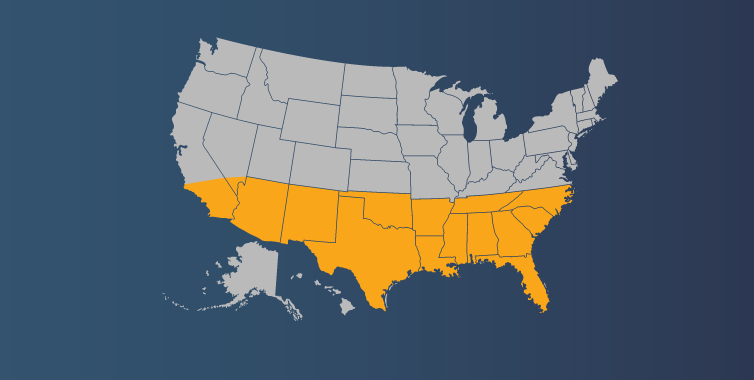
One of the strongest structural themes in U.S. CRE remains the long-term migration of people, companies, and capital toward the Sun Belt. According to the U.S. Census Bureau, the U.S. population grew by 1.8 million, or 0.5%, between July 2024 and July 2025, while the South remained the fastest-growing region at 0.9%. Metro areas also continued to outperform non-metro areas, growing 0.6% during that period. These shifts support demand for industrial space, neighborhood retail, multifamily housing, and service-oriented commercial assets in high-growth metros.

For Allion Fund 1, this matters because migration and job growth directly influence collateral quality, leasing demand, rent growth potential, and borrower performance.

Key CRE Markets Relevant to Allion Fund 1

The current market map strongly supports a Sun Belt-focused investment lens. In the PwC and Urban Land Institute Emerging Trends in Real Estate 2026 rankings, Dallas-Fort Worth remained the number one U.S. market to watch, followed by Miami at number three, Nashville at number six, Tampa-St. Petersburg at number eight, and Phoenix at number ten.

That aligns well with the compiled investment areas for Allion Fund 1:

Primary Markets

Secondary & Growth Markets

Why This Matters for a Secured Lending Fund?

For a fund like Allion Fund 1, LP, the U.S. CRE market offers more than appreciation potential. It offers the ability to structure investments through real estate-secured lending, where capital is supported by tangible collateral, legal documentation, and asset-level underwriting. This creates a more defensive pathway into commercial real estate, allowing investors to participate in income-producing opportunities without taking on the operational burden of direct ownership.

In the current environment, that approach is especially relevant. The market is not moving uniformly, but it is offering selective opportunity across growth metros, industrial corridors, multifamily recovery zones, and well-positioned commercial assets. A disciplined lending strategy focused on asset quality, borrower strength, and market fundamentals can therefore benefit from both income generation and downside protection.

Invest Now
1
Allion Fund 1
2
Key Investment Highlights
3
U.S. CRE Market
4
Fund Management